


The Problem
Health disparities exist not only between the haves and the have-nots but also between those who know and those who don't
Being able to self-triage, knowing where to go, what to say, how much it will cost, and how to afford medical bills are just a few of the many things required for a successful patient journey—and 70% of which occurs outside of the clinic.
Mistakes in healthcare can be expensive, and the statistics are concerning: over half of Emergency Department (ED) visits today are preventable, avoidable, or non-urgent. Even with insurance, an unnecessary trip to the ED can cost between $2,000 to $3,000 due to high deductibles.

Consumer behaviors have changed
Moreover, consumers' behaviors have evolved more rapidly than the U.S. healthcare delivery system can adapt. In an era of instant online purchases and two-day shipping, waiting days for a diagnosis can be frustrating, especially for younger Millennials and Gen Z.
“Consumers today want it quick, they want it cheap, and to move on with life.”
“Consumers today want it quick, they want it cheap, and to move on with life. Our interactions with existing members have revealed that people are increasingly comfortable with forming relationships through multiple touchpoints and exhibit flexibility in machine-assisted human interactions. Younger demographics, in particular, tend to prefer non-face-to-face care settings, as indicated by the growth of asynchronous telemedicine and its non-confrontational nature.”, Majorie Harris, Director of Operations at Mira.
Mira's Journey Into Artificial Intelligence
We believe that building single-point AI solutions is not the answer; instead, integrating AI into the care journey where it fits
Through research, we identified two areas of opportunity: pre-triage and self-care. Mira has developed Beacon, an AI-powered suite of companions that streamlines access to care:
- BeaconAI – Intelligent patient intake, symptom checking, and care navigation.
- Beacon Emotional Companion – Mental health assistance.
- Beacon SkinCheck – Dermatological image recognition.
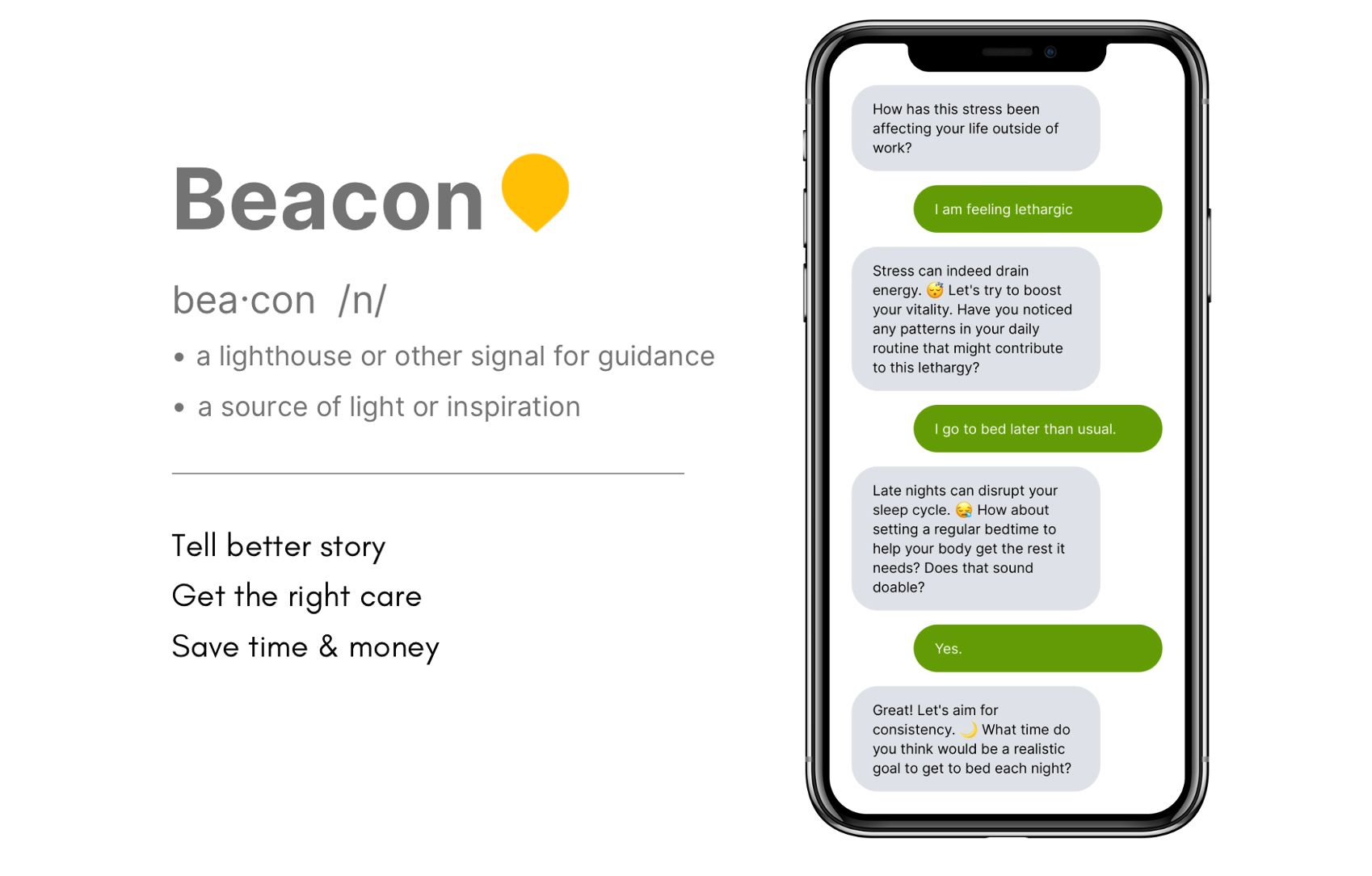
We launched a Beta version of BeaconAI earlier this year to provide members with a single starting point for all their care needs. Users input their health concerns into Beacon, answer relevant questions to narrow down potential conditions, and are then presented with appropriate Mira care options and self-care tips. “In the first two weeks post-launch, Beacon accounted for 33% of total encounter volume, with 20% of users utilizing Beacon more than twice”, Shrihdar Gambhir, Product Lead at Mira.
“In the first two weeks post-launch, Beacon accounted for 33% of total encounter volume, with 20% of users utilizing Beacon more than twice.”
Building An Emotional Companion
Analysis of use cases revealed that approximately half of the issues presented were related to behavioral health services, which Beacon validated and appropriately directed to our virtual mental health partner. This led to the launch of Beacon Emotional Companion (BEC), an emotional companion using research-based principles for 20-30-minute conversations. BEC also has critical guardrails built in such as prompting users to seek emergency help or direct call to the suicide prevention hotline if certain intent is detected.

Next, Mira is launching Beacon SkinCheck, aimed at streamlining patient intake for dermatological conditions. Using image recognition, SkinCheck will enable users to identify potential causes of skin conditions, allowing our care navigation team to direct members to the appropriate specialist.
BeaconAI serves as the initial point of contact for any member seeking care. It determines the necessary next steps based on the information provided and activates the relevant module for the member. For instance, a deep laceration would trigger the in-person care request flow for an urgent care clinic visit, while anxiety symptoms would activate the mental health module for a conversation with Beacon Companion or a virtual visit with a therapist. Interactions with Beacon are secure, data is de-identified and stored within Mira's infrastructure, ensuring privacy.
Through intelligent categorization, BeaconAI identifies the required service type and triggers the appropriate Mira service modules. This integration offers users a seamless flow throughout their entire care journey, with Beacon providing assistance at every stage.
What Does The Future Hold?
The rise of AI is inevitable, but how will it integrate into healthcare
While AI is neither good nor bad, we believe the case for AI in healthcare isn’t one “transformative” or game-changing solution, but its infusion within the care journey to produce tangible results, without changing the “look” and “feel” of medicine. This is the first of many, and we hope it won’t be the last. Because at the end of the day, healthcare as a service is based on knowledge, and when we start losing patients’ trust, the value of the service is reduced to zero.
To maintain trust, Beacon discloses its limitations and sets boundaries when providing helpful information. For example, instead of asking the user to take a specific action, Beacon provides an optimal range of options for the user to decide. The goal here isn’t to replace Doctor Human with DoctorAI, but to narrow down the knowledge gap so that members can make high-quality decisions and reduce the duration of care by at least half.
What's Next?
As the name “Beacon” suggests, we want this new feature to function as a source of light for those who seek directions, rather than taking over the decision-making process.
Starting with pre-triage and self care, we want to see how it will affect patient outcome and speed of resolution. From there, we want to expand the scope of implementation to include other parts of the care journey. The goal is to develop a single entity that is secured, personalized, and helpful to members to help them achieve the most optimal outcome in the shortest amount of time and at the lowest possible out-of-pocket costs.